

My Story
Eternal optimists, my parents’ hope plummeted when my dad was diagnosed with Parkinson’s in 2013. Their assets (a home and a modest life savings) were not enough to cover the likely cost of long-term care, let alone leave my mom with anything to live on once all their finances were exhausted.
Through tears, my mom explained that the internet suggested a shortcut called “Medicaid Divorce” where she would keep their assets, and my dad would rely on Medicaid to pay for his long-term care. Already coming to painful terms with the diagnosis, my parents were suddenly faced with the prospect of severing the bonds of a 40-year marriage to the love of her life.
Their stress and worry was painful to witness. Fortunately, they had an elder law attorney in their midst to explain that while there was nothing to avoid the pain of Parkinson’s taking my dad’s health, it didn’t have to take their money or their marriage.
Community Spouse Resource Allowance and Community Spouse Maintenance Needs Allowance
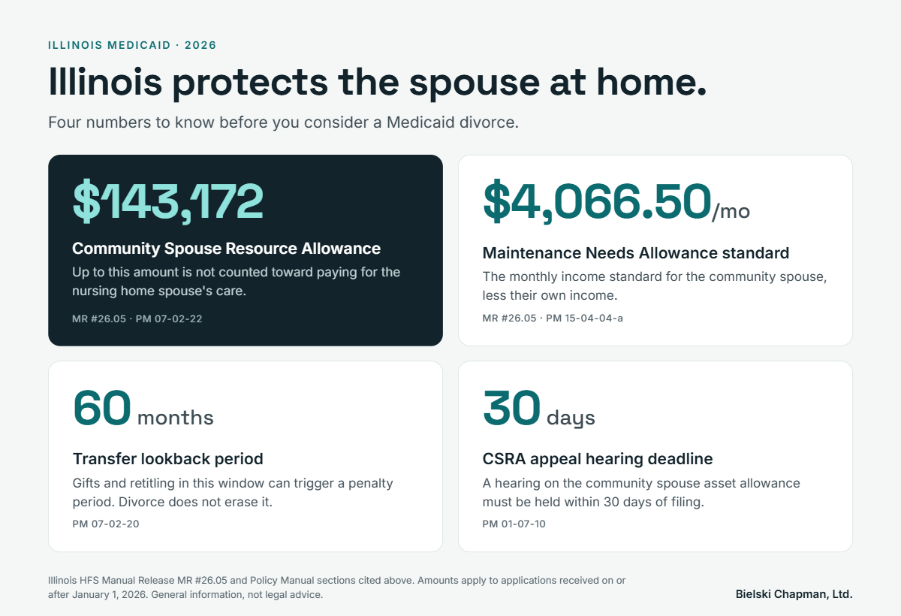
While Medicaid requires an unmarried person to have less than $17,500 to get coverage, married couples can have $143,172.001 and their home2 and still qualify for coverage.3 Medicaid also applies a 5 year “lookback” in which any transfer for less than fair market value (usually gifting, or ill-advised estate planning such as adding an adult child to a deed or joint account) imposes a penalty period in which Medicaid will not cover the applicant.4 Divorce doesn’t erase any of those gifts. If the applicant spouse gives up more than a fair share in the settlement, Medicaid can treat the difference as a transfer, and that is a dangerous game.
If the spouse at home has less than $4,066.50 a month in income, Medicaid lets them keep part of the nursing home spouse’s income to make up the difference.5 That amount can be increased with a court order or fair hearing.6
What Is a “Medicaid Divorce”? (And Is It a Real Strategy?)
Medicaid Divorce is a perceived shortcut to separate a married couple’s assets into two buckets: one that the community spouse can keep, and one that belongs to the spouse in long-term care, who (in theory) benefits from the divorce to qualify for Medicaid.
Divorce is legal, and nothing in Illinois Medicaid policy prohibits it, but Medicaid’s transfer rules still apply,7 and in my experience the cons far outweigh the pros. I’ll start with the most obvious. Let’s say my parents had divorced. My dad would have kept $17,500 in his own name, and my mother would have gotten the home and their life savings.
Medicaid would look at that as my dad having gifted away ½ of everything he and my mom owned together, for less than fair market value. It would impose a penalty period and there would be no one to pay for months or years of long-term care. My mom would still have used ½ of everything she got to privately pay for long-term care.
Not only would they have lost their marriage and ½ their assets, but they also would have lost the thousands or so that it costs for the divorce, plus the sacrifice of the time that could have been leveraged to save more money rather than waste it.
Plus, if my mom ever needed long-term care after my dad’s death, she would only be allowed to have $17,500 and she would also be faced with losing her house and life savings to pay for care.
They would have been worse off on every single front!
The key takeaway is that a property division in a Medicaid Divorce can backfire, leaving the nursing home spouse with no Medicaid payment for care.
Why Families Consider Divorce When a Spouse Needs Nursing Home Care
Medicaid Divorce is a fear-based decision that people often rush into when faced with the prospect of the exorbitant costs of urgently needed long-term care. They fear the community spouse will end up penniless.
Medicaid Divorce is a dangerous game that can set a couple back even further than when they were married, so it’s critical to consider all the other options available to couples when one of them has a diagnosis.
How Illinois Lets You Protect Assets From Nursing Home Costs Without Divorce
Illinois follows the federal Medicaid spousal impoverishment rules: a policy against leaving the spouse at home penniless, meaning there are many legal ways to qualify a spouse with a diagnosis for long-term care coverage by Medicaid without having to divorce. This is a form of Medicaid asset protection, and it protects assets from nursing home care in Illinois.
Community Spouse Medicaid Illinois: Income Protection (CSMNA)
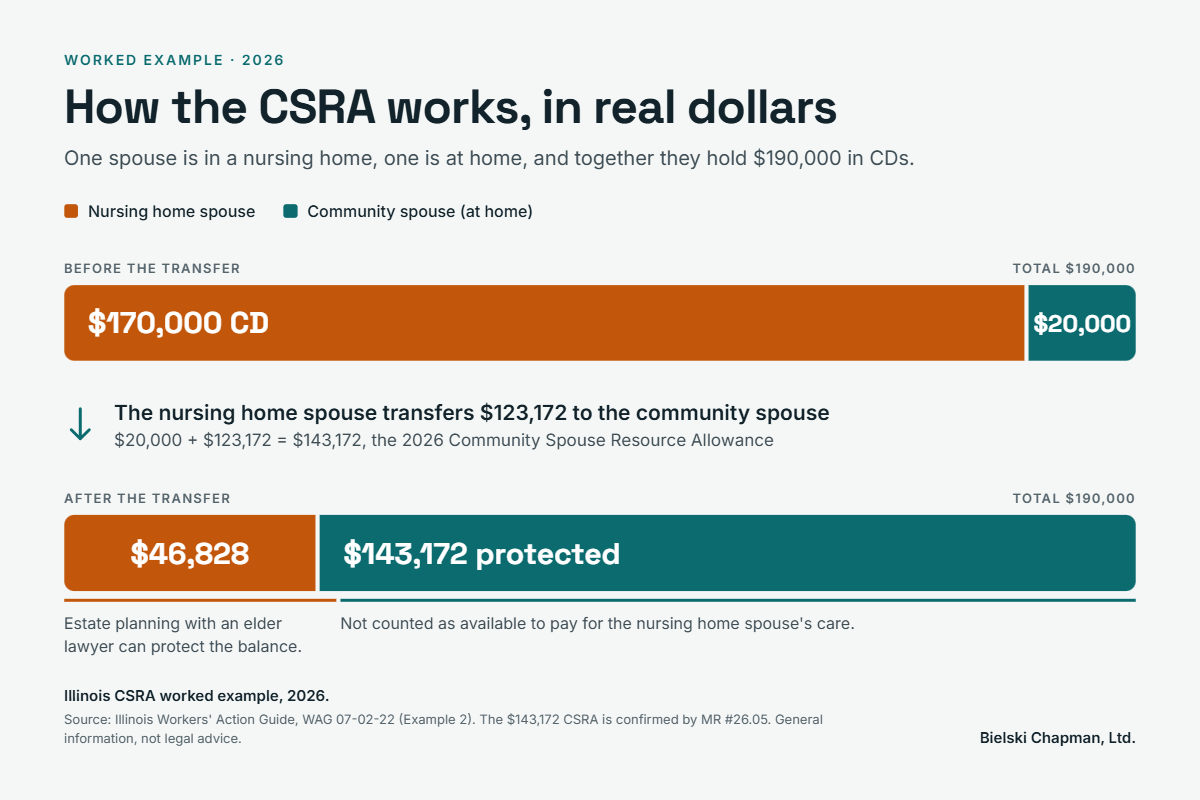
As mentioned above, under Illinois’ public policy against spousal impoverishment, a couple can divert the income from the spouse in long-term care to the spouse at home, so that the spouse at home makes up to $4,066.50 a month in income. This is the Community Spouse Maintenance Needs Allowance.
What If the Standard Allowance Isn’t Enough?
This amount is often not enough to support the community spouse. That is why Medicaid offers a procedure to divert even more from the spouse in a nursing home: a fair hearing.8 The hearing officer can allow more of the couple’s assets to move to the community spouse, above the usual $143,172, so those savings produce enough income to close the gap.9
What the Community Spouse Keeps on Top of the CSRA
In Illinois, a Community Spouse has plenty of ways to keep assets protected from Medicaid. Medicaid allows an unlimited number of personal effects10 and household goods, a vehicle, and a primary residence.11
I describe this as putting an invisibility cape over your assets. Take cash and use it to improve the value of the residence; put the addition on you’ve always wanted or make those expensive repairs you’ve been putting off. Purchase something expensive that will hold its value so it can be liquidated in the future – one elder law attorney I know suggested a male client purchase in his first Rolex, and her female client buy herself a diamond anniversary ring! Maybe it’s an excuse to purchase the vehicle of your dreams.
Illinois Medicaid Asset Protection Going Forward: Why Future Assets Stay Separate
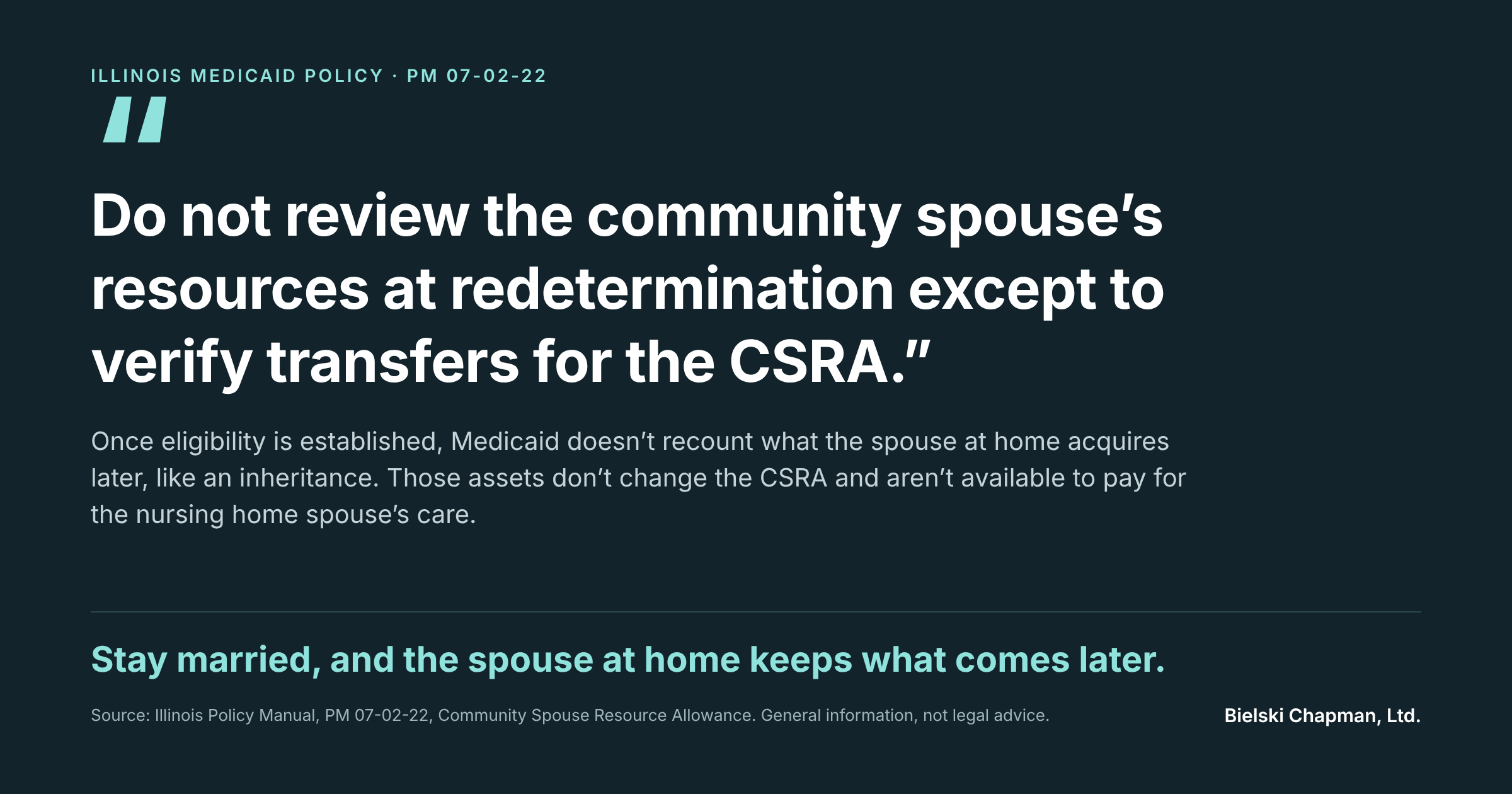
Once transferred, the community spouse’s assets stay separate and aren’t ever examined again by Medicaid.12 That means that the Rolex or the dream car the community spouse purchased can be liquidated and converted back to cash if needed, and the invisibility cloak now covers the cash! Or the upgraded home can be sold and the spouse can buy a less expensive home and keep the cash.
What Else a Medicaid Divorce Can Cost You: 1,138 reasons not to divorce.
Medicaid isn’t the only thing that changes when a marriage ends. Divorce affects income, health coverage, inheritance, and who makes decisions for you. See this blog I wrote about the 1,138 rights attached to marriage!
Social Security
Marriage entitles you to Social Security on your spouse’s record. A surviving spouse can receive up to 100% of the amount that the deceased spouse was getting. After a divorce, you can still claim on your former spouse’s record only if the marriage lasted at least 10 years. You must also be unmarried and at least 62. A couple married for decades may keep these rights, but the conditions have to be met, and a marriage of under 10 years will not qualify.
Pensions and retirement accounts
The death benefit on a pension plan can go to a current spouse, but not a former spouse unless there was a divorce decree and court order directed to the plan (called a QDRO). In a Medicaid Divorce, the savvy practitioner must understand the complex rules regarding taxation and divestment to properly structure a pension to preserve the community spouse’s death benefit.
Health coverage
Employer health plans generally cover a spouse but not a former spouse.
Inheritance
A surviving spouse has automatic legal rights to a share of their spouse’s estate. There is no such automatic right post-divorce, which can also cancel gifts to the former spouse in the other’s will or trust.
Beneficiary designations
Life insurance, retirement accounts, and payable-on-death accounts that name a spouse may be revoked automatically by divorce or may need to be updated, depending on the type of account.
Taxes
Your filing status changes, and so can your tax rate. Transfers between spouses as part of a divorce are generally not taxed, but the receiving spouse takes the original cost basis, which can mean a larger tax bill when assets are sold later. Selling the home can also change the capital gains exclusion, which is $250,000 for a single filer and $500,000 for a married couple filing jointly, if they meet the requirements.
Decision-making authority
A spouse is usually first in line to make medical decisions if you can’t, and is often named in your powers of attorney. After a divorce, a former spouse generally loses that role, and your documents may need to be redone. Without valid documents, a family might need a court-appointed guardian which is an expensive and stressful process in which a judge, not the community spouse, decides what’s in the nursing home spouse’s best interests.
Nursing Home Medicaid Planning Illinois: What to Model Before Considering Divorce
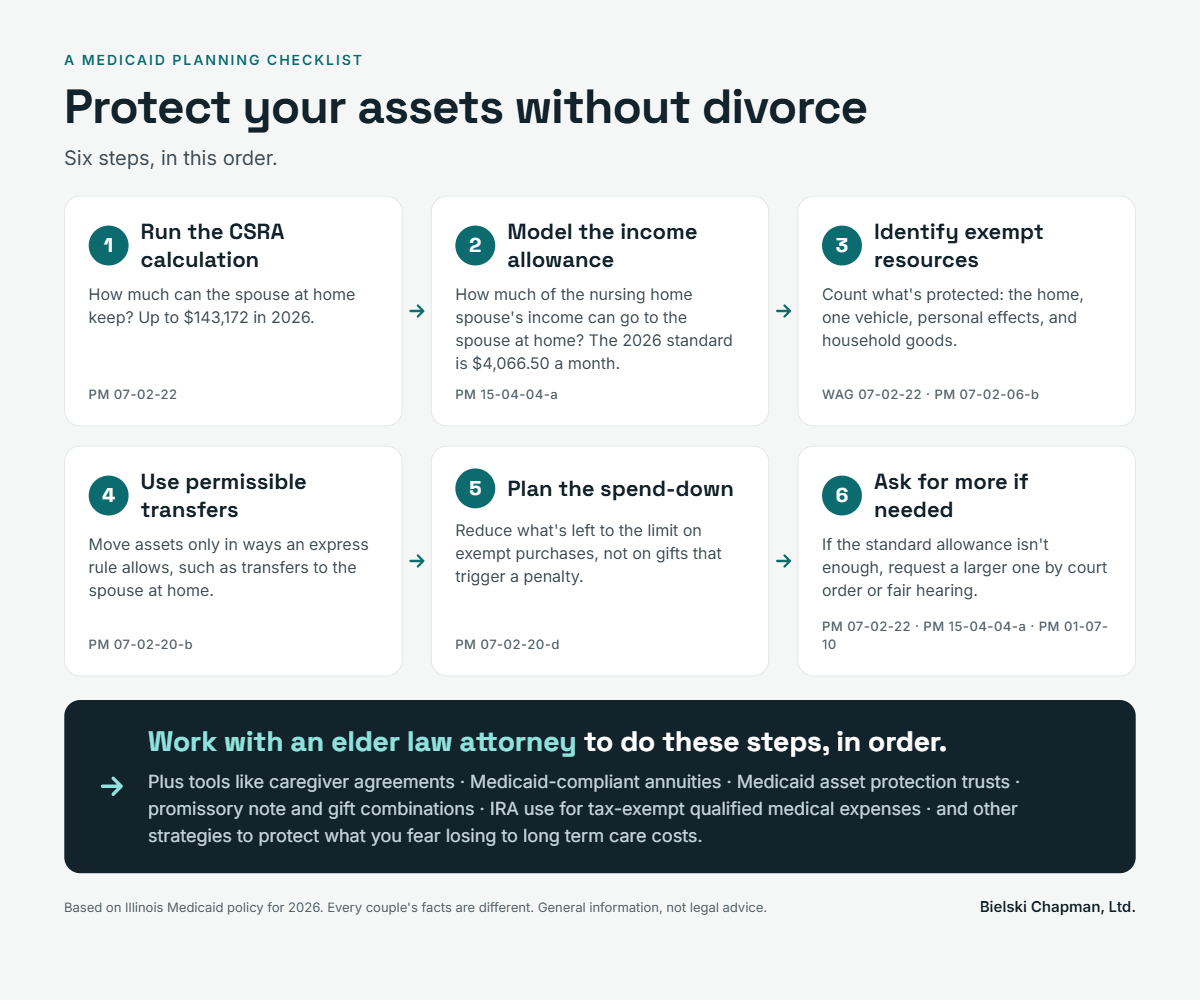
Before you consider a Medicaid Divorce, first consider the increased CSRA and the CSMNA, in addition to exempt resources and permissible transfers.
My office frequently employs tools such as caregiver agreements, Medicaid compliant annuities, promissory note/gift combinations, use of IRA on tax exempt qualified medical expenses, and other strategies to protect any asset that a couple fears they might lose to long-term care costs
FAQs
When Might a Medicaid Divorce Make Sense?
In my experience, it hasn’t yet. But I imagine that it would make sense for a couple whose marriage was already over for reasons that have nothing to do with Medicaid. I have yet to see a case where every other tool has been modeled and none of them can protect enough, but perhaps it might make sense when a couple’s assets are very large relative to the protections Illinois allows.
Even then, the divorce has to be a real one, and it has to be structured with Medicaid’s transfer rules in mind. A property settlement that leaves the spouse needing care with far less than a fair share can be treated as a transfer for less than fair market value, which can trigger a penalty period. If one spouse has dementia, there are also questions about whether they can take part in the case at all.
That’s why this decision should never be made alone or on the advice of a single lawyer. An elder law attorney Medicaid asset protection review should come first, so the real numbers are on the table before any filing. If a divorce is still on the table after that, your elder law attorney and a family law attorney need to work together on the settlement.
Is a Medicaid divorce legal?
Yes. Divorce is legal, and nothing in Illinois Medicaid policy prohibits it. But Medicaid’s transfer rules still apply, and Illinois reviews divorce settlements to ask whether the person received fair market value for what they gave up and you could end up losing half your assets, the money to get divorced, and the rights incident to marriage.
Can I get a divorce to qualify for Medicaid?
You can file for divorce, but it is unlikely to work the way you hope. If the nursing home spouse gives up more than a fair share in the divorce, Medicaid will treat the difference as a transfer for less than fair market value and impose a penalty period. During that period, Medicaid will not cover the applicant’s care. In Perlstein v. Dimas, a husband divorced his wife of 50 years after he entered long-term care, and Medicaid still imposed a 12 month penalty period. Illinois already lets a married couple qualify without divorcing, so divorce to qualify for Medicaid is rarely necessary.
Does divorce erase the look-back period?
No. Medicaid applies a 60-month look-back to any transfer for less than fair market value. That includes gifts and ill-advised estate planning, such as adding an adult child to a deed or joint account. Divorce doesn’t erase those transfers, and it can add a new one if the settlement is lopsided.
Will Medicaid look at my divorce?
Yes. Illinois reviews divorce settlements to see whether the person received fair market value for what they gave up. A settlement that leaves the spouse needing care with far less than a fair share can trigger a penalty period.
How much can the spouse at home keep in Illinois?
Under Illinois’ Medicaid spousal impoverishment rules, a married couple can keep up to $143,172 in 2026 and their home and still qualify for coverage. The spouse at home can also keep personal effects and household goods and a vehicle. On income, if the spouse at home has less than $4,066.50 a month, Medicaid lets them keep part of the nursing home spouse’s income to make up the difference. That amount can be increased with a court order or fair hearing.
What can we do instead of divorcing?
Talk to an Elder Law Attorney About Medicaid Planning
A Medicaid diagnosis doesn’t have to cost your family its savings or its marriage. My parents learned that, and I’ve spent my career helping other families learn it too.
We can help by assessing the community spouse’s resource allowance, the income allowance, exempt resources, and permissible transfers. We can also consider tools such as caregiver agreements, Medicaid-compliant annuities, promissory note/gift combinations, and using an IRA for tax-exempt qualified medical expenses, all aimed at protecting assets a couple fears losing to long-term care costs.
Before anyone files for divorce, get an elder law attorney Medicaid planning review. We’ll put the real numbers on the table, including the CSRA, the income allowance, exempt assets, and permissible transfers, and show you what can be protected without ending your marriage.
Schedule your strategy session
Attorney Advertising. This article is general information, not legal advice, and reading it does not create an attorney-client relationship. Medicaid rules and dollar limits change, figures are for 2026, and every family’s facts are different, so talk to a licensed attorney about your situation. Bielski Chapman, Ltd., 123 N. Wacker Dr., Suite 2300, Chicago, Illinois 60606, 312-583-9430
References
1. Illinois 2026 spousal impoverishment limits and the $17,500 exemption
2. Homestead property is an exempt asset
3. Primer/refresher on how Medicaid actually works.
4. The lookback period is 60 months. Illinois adds up everything you gave away for less than fair market value and divides that total by the monthly private-pay rate. The result is the number of months Medicaid won’t pay for long-term care, and there is no maximum. For example: a $50,000 non-allowable transfer at a $5,000 monthly private rate produces a 10-month penalty.
5. This is the January 1, 2026 MMNA rate; it usually increases yearly. For example, in 2026, if the spouse at home has $2,500 in monthly income, the allowance would be $1,566.50
6. Because the MMNA rate is too low for many, Medicaid allows people to increase it via a court order or fair hearing.
7. Illinois reviews divorce settlements to ask whether the person received fair market value for what they gave up. 89 Ill. Adm. Code § 120.388. In Perlstein v. Dimas, a husband divorced his wife of 50 years after he entered long-term care. The settlement left him about $123,000. It left her the home, $88,000, a car, and about $766,000 of her own non-marital property. Medicaid imposed a 12 month penalty period. They would have been better off staying married and doing Medicaid Asset Protection planning for nursing home care.
8. 42 U.S.C. § 1396r-5(e)(2)(B)–(C); 89 Ill. Admin. Code § 120.379(f); Wisconsin Dep’t of Health & Family Servs. v. Blumer, 534 U.S. 473 (2002) (income must be counted first, before any increase in the resource allowance); Harris v. Dep’t of Human Servs., 345 Ill. App. 3d 764 (2004) (the spouse must prove the specific extra amount is necessary). See also PM 15-04-04-a and PM 07-02-22 (higher amounts by court order or fair hearing), and PM 01-07-10 (CSRA appeal hearing within 30 days).
9. Say the spouse at home has $1,500 a month of their own income, and the nursing home spouse has $1,800 a month available after the personal needs allowance. Even with all $1,800, the spouse at home reaches only $3,300, which is $766.50 short of the $4,066.50 standard. At an assumed 4% return, it would take roughly $230,000 in additional savings in the spouse at home’s name to produce that $766.50 a month. Or a court can order a higher maintenance needs allowance.
10. In Illinois, community spouses are allowed to have personal effects regardless of value, defined as “items worn or carried… such as clothing, jewelry, recreational equipment, and hobby items. Household goods are those items normally found in the home such as furnishings, appliances, television sets, and dishes.
11. 89 Ill. Adm. Code § 120.381(a)(2) (personal effects and household goods are excluded resources, incorporating 20 C.F.R. § 416.1216, which sets no dollar limit); 89 Ill. Adm. Code § 113.141(a)(2)(B) (personal effects and household goods are excluded “regardless of value” when calculating the community spouse’s resources). The exclusion does not cover items acquired or held as an investment, such as jewelry that is not worn. See 20 C.F.R. § 416.1216.
12. A community spouse’s resources aren’t reviewed at redetermination except to verify the CSRA transfers, and that applies after eligibility is established.
